The family is everywhere. Its memory is in pieces.
Many families now live across three or four countries. Indian, Pakistani, Bangladeshi, Sri Lankan, Filipino, Lebanese, Irish: the story is the same. The elders stay in one place, and the children and grandchildren grow up in others. The old photos stay in a cupboard at the family home. The stories stay with the people who were there.
A grandchild in Melbourne can't ask her grandmother about the photo on the wall, because the wall is in another country. By the time she thinks to ask, it may be too late.
Why not a WhatsApp group?
Most families already have one, or several. They're good for news and good wishes. They're not good for keeping things. Photos scroll away under a week of messages. They're usually sent compressed. Nobody can find the wedding photo from 1987 again, or say who the man on the left is. And each branch has its own group, so half the family never sees what the other half shared.
Kumbaa doesn't replace the chat. It's where things go to be kept: the tree, every photo filed by person, album and decade, and each person's story on their own page.
Who's who, and what do I call them?
English has one word, "uncle", where Hindi and Urdu have chacha, taya, mama, phupha and mausa. Children raised abroad often don't know which one someone is.
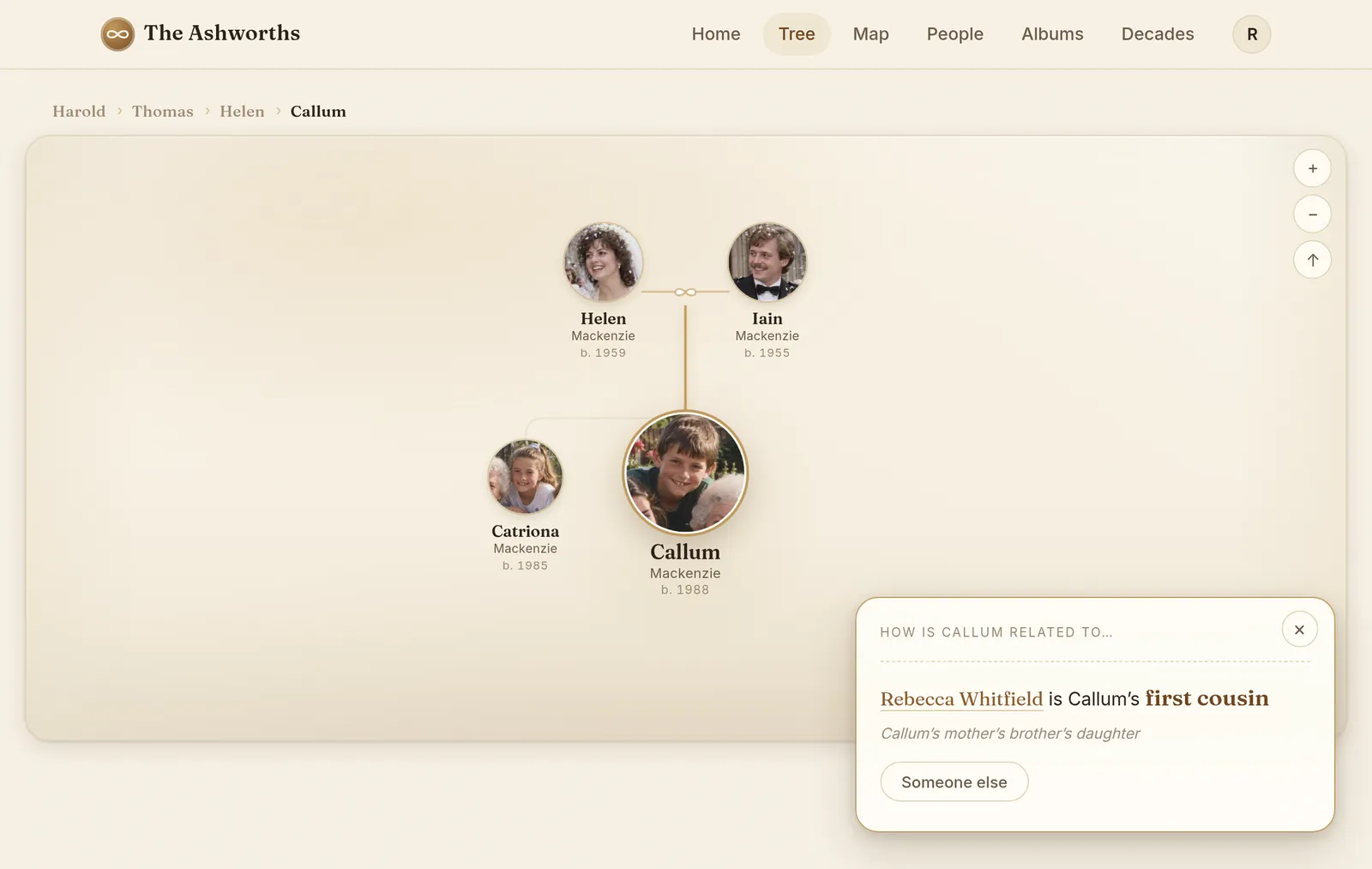
"How are we related?" helps. Pick any two people and Kumbaa names the relationship in English and spells out the path: "your father's brother", "your mother's sister's husband". The path tells you whether he's a chacha or a mausa. Whether he's older or younger than your father, and so a taya, is still a question for the family. Our page of relationship names and the relationship calculator help too.
How does it work for a family abroad?
- One person starts the archive. It gets its own private address, and only people they invite get in.
- Invite everyone by email, in any country. They join free.
- Each relative fills in their own branch: their parents, brothers and sisters, children and grandchildren.
- Whoever has the old photos scans them. Faces are named once and found in the rest.
- "This month" on the home page shows whose birthday or anniversary is coming, wherever they live.
When someone marries into another family, their side can have an archive of its own, linked to yours at them. Children can walk up both sides.
Start with what's at risk
If there are old photos and elders who can name the people in them, start there. Our guides on digitizing family photos and questions to ask your grandparents work over a video call as well as in person.