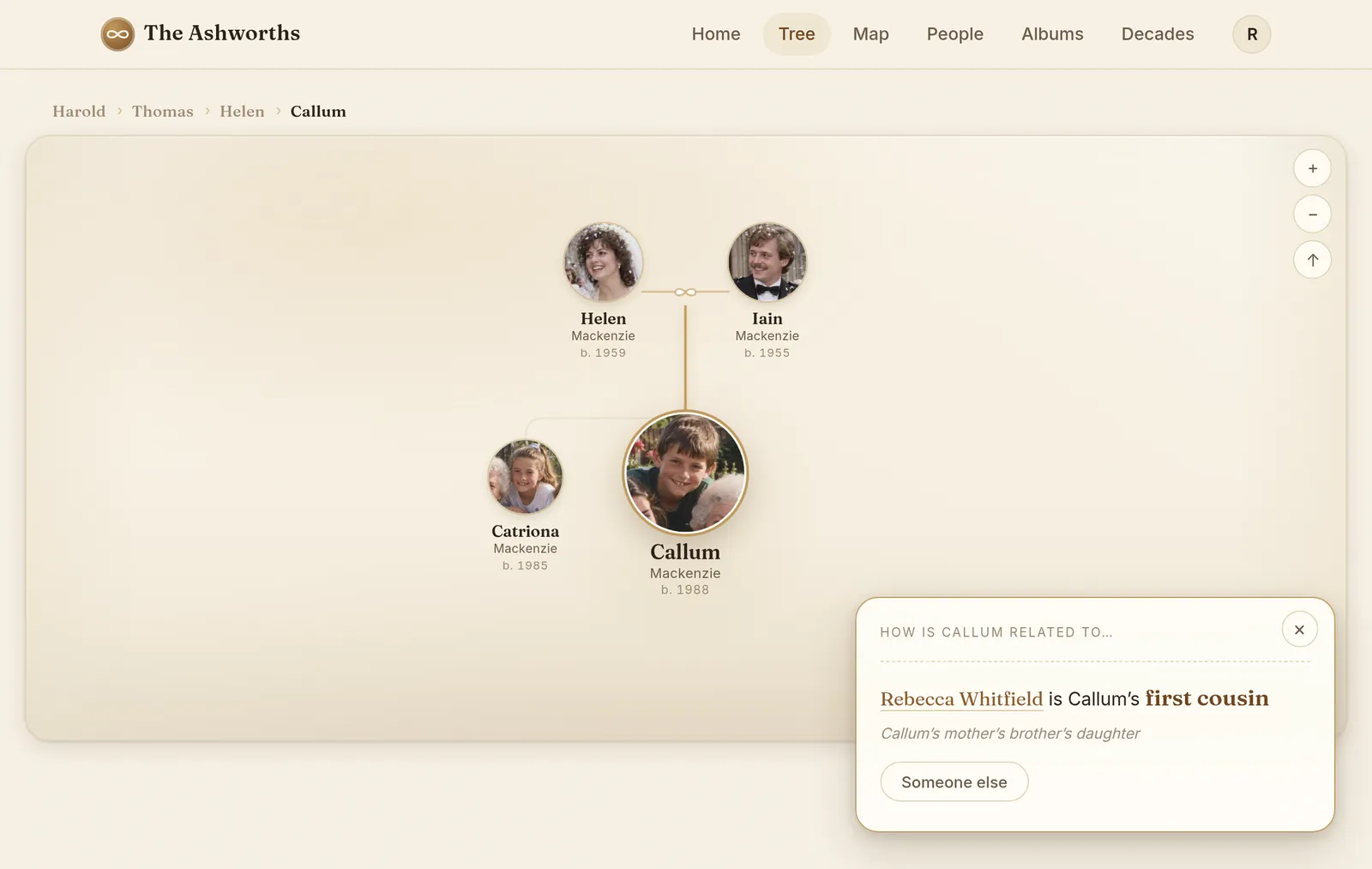
What does it tell you?
Two things. First, the name of the relationship: first cousin, great-aunt, second cousin once removed. Second, the path, in plain words: "Callum's mother's brother's daughter". The name is the short answer. The path is the one you can check, and the one that makes sense to a child.
It's in every person's panel in the tree. Open someone and ask how they're related to you, or to anyone else in the family.
Why is the path useful?
English uses one word for many relationships. "Uncle" can be your father's brother, your mother's brother, or the man your aunt married. Many languages have a separate word for each, like chacha, mama and phupha in Hindi and Urdu. The path tells you exactly which one someone is, so you can call them the right thing. Our list of relationship names has more.
It also settles the arguments at family weddings. Is she your second cousin, or your first cousin once removed? The path shows how you got there, step by step.
It follows marriages as well as blood. Your brother's wife is your sister-in-law, and for someone further away, the path still says it plainly: "your brother's wife's sister".
How is the relationship worked out?
Kumbaa finds the closest ancestor the two people share, then counts how many generations each of them is from that ancestor. If you're both two generations down, you're first cousins. Both three, second cousins. If one of you is a generation further down, that's "once removed". The cousin chart lays this out as a grid, and our guide to cousin relationships explains it with worked examples.
Can I try it without signing up?
Yes. The free relationship calculator asks how each of you is related to a shared ancestor and gives you the answer. It's handy for a quick question. In your own archive you don't need to answer anything: the tree already knows the path.
Where it helps most
- Big families where nobody is quite sure how everyone fits.
- Children and grandchildren who've grown up far from the rest of the family.
- Reunions and weddings, when you're meeting relatives for the first time.
- Linked archives, where someone who married in brings their side of the family.
It works as well as the tree does. The more of the family you add, the further it can reach. Start with the family tree, or import one you already have.