The problem with one big tree
Every marriage joins two families. If you put both into one tree, it grows sideways forever, and each family ends up looking at the other's photos and stories. If you keep them apart, the person who married in has to choose a side. Kumbaa does neither.
How do linked family archives work?
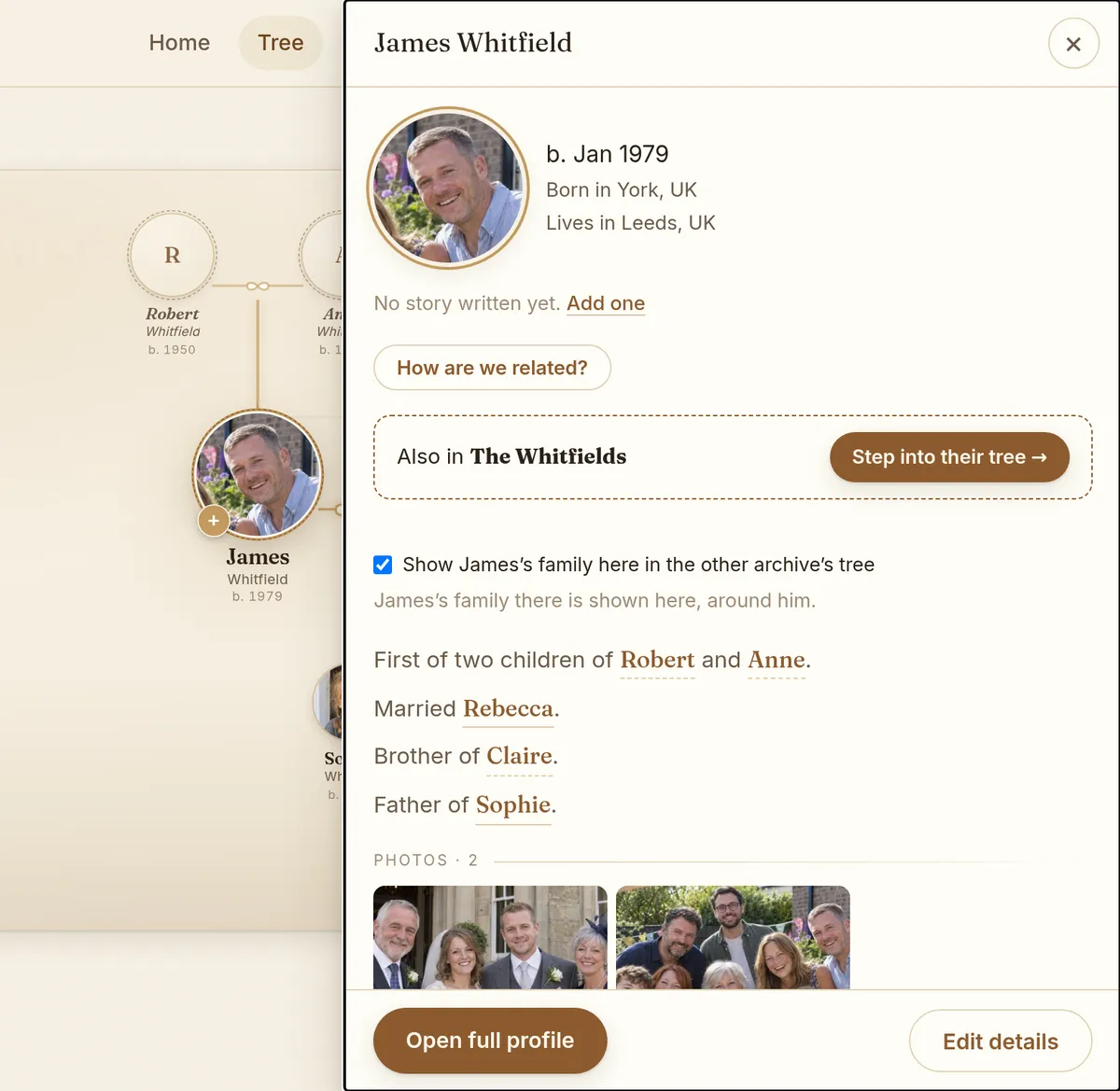
Take James, who married into the Ashworths. He's in the Ashworths' tree as Rebecca's husband, and he's also his own parents' son. From his place in the Ashworths' tree, he can start his side of the family: a new archive of its own, which he owns, with his details copied in as its first entry. The two are linked at him.
The tree shows a door on his face, with a dashed ring. Members of both families can step through it, straight into the other tree at the same person, and come back with one tap.
You can start the other side from anyone you're allowed to edit whose parents aren't already in your tree. A curator can also link a person to someone in an archive that already exists, if they curate that one too.
What does each family see of the other?
Through the door, each family sees the person's immediate family on the other side, as faces around them in the tree: husband or wife, children, parents, brothers and sisters. Only names, dates, places and portraits come across. Never photos, stories or contact details. Those faces are read-only, and their panel says whose tree they're in.
Nothing is copied between the archives. Each family keeps its own photos, its own stories, and its own members. A curator can turn off what their side shows through the door.
Who can go through?
- Members of both families step through freely.
- Anyone a curator has put on the other family's invitation list can go through and join.
- Everyone else sees only that there's a door. Not the other family's name, and not its address.
Why it matters
Children belong to both sides. With linked archives, they can walk up one side to their great-grandparents, then step across at their mother and walk up the other. "How are we related?" works inside each tree, and each family stays as private as it was.